sábado, 31 de janeiro de 2015

The quarters should be the best that can be provided

The quarters should be the best that can be provided

The quarters should be the best that can be provided


Treatment. The comfort and surroundings of the patient must be attended to first. The quarters should be the best that can be provided. Pure air is essential. Avoid placing the animal in a stall where he may be exposed to drafts of cold air and sudden changes of temperature. It is much better for the animal if the air is cold and pure than if it is warm and foul. It is better to make the animal comfortable with warm clothing than to make the stable warm by shutting off the ventilation. From the start the animal should have an unlimited supply of fresh, cold drinking water. Blanket the body. Rub the legs until they are warm and then put bandages on them from the hoofs up to the knees and hocks. If warmth can not be reestablished in the legs by hand rubbing alone, apply dry, ground mustard and rub well in. The bandages should be removed once or twice every day, the legs well rubbed, and the bandages replaced. Much harm is often done by clipping off hair and rubbing in powerful blistering compounds. They do positive injury and retard recovery, and should not be allowed. Much benefit may be derived from hot application to the sides of the chest if the facilities are at hand to apply them. If the weather is not too cold, and if the animal is in a comfortable stable, the following method may be tried: Have a tub of hot water handy to the stable door; soak a woolen blanket in the water, then quickly wring as much water as possible out of it and wrap it around the chest. See that it fits closely to the skin; do not allow it to sag so that air may get between it and the skin. Now wrap a dry blanket over the wet hot one and hold in place with three girths. The hot blanket should be renewed every half hour, and while it is off being wetted and wrung the dry one should remain over the wet part of the chest to prevent reaction. The hot applications should be kept up for three or four hours, and when stopped the skin should be quickly rubbed as dry as possible, an application of alcohol rubbed over the wet part, and a dry blanket snugly fitted over the animal. If the hot applications appear to benefit, they may be tried on three or four consecutive days. Unless every facility and circumstance favors the application of heat in the foregoing manner, it should not be attempted. If the weather is very cold or any of the details are omitted, more harm than good may result. Mustard may be applied by making a paste with a pound of freshly ground mustard mixed with warm water. This is to be spread evenly over the sides back of the shoulder blades and down to the median line below the chest. Care should be taken to avoid rubbing the mustard upon the thin skin immediately back of the elbow. The mustard-covered area should be covered with a paper and this with a blanket passed up from below and fastened over the back. The blanket and paper should be removed in from one to two hours. When pneumonia follows another disease, the system is always more of less debilitated and requires the careful use of stimulants from the beginning. To weaken the animal still further by bleeding him is one of the most effectual methods of retarding recovery, even if it does not hasten a fatal termination.

sexta-feira, 30 de janeiro de 2015

The breathing becomes still more rapid and difficult

The breathing becomes still more rapid and difficult

The breathing becomes still more rapid and difficult


When a fatal termination is approaching all the symptoms become intensified. The breathing becomes still more rapid and difficult; the flanks heave; the animal stares wildly about as if seeking aid to drive off the feeling of suffocation; the body is bathed with sweat; the horse staggers, but quickly recovers his balance; he may now, for the first time during the attack, lie down; he does so, however, in the hope of relief, which he fails to find, and with difficulty struggles to his feet; he pants; the nostrils flap; he staggers and sways from side to side and backward and forward, but still tries to retain the standing position, even by propping himself against the stall. It is no use, as after an exhausting fight for breath he goes down; the limbs stretch out and become rigid. In fatal cases death usually occurs in from 10 to 20 days after the beginning of the attack. On the other hand, when the disease is terminating favorably the signs are obvious. The fever abates and the animal gradually improves in appetite; he takes more notice of things around him; his spirits improve; he has a general appearance of returning health, and he lies down and rests. In the majority of cases pneumonia, if properly treated, terminates in recovery.

quinta-feira, 29 de janeiro de 2015

By auscultation important information may be gained

By auscultation important information may be gained

By auscultation important information may be gained


By auscultation important information may be gained. When the ear is placed against the chest of a healthy horse, the respiratory murmur is heard more or less distinctly, according to the part of the chest that is beneath the ear. In the very first stage of pneumonia this murmur is louder and hoarser; also, there is a fine, crackling sound something similar to that produced when salt is thrown in a fire. After the affected part becomes solid there is an absence of sound over that particular part. After absorption begins one may again hear sounds that are of a more or less moist character and resemble bubbling or gurgling, which gradually change until the natural sound is heard announcing return to health.

quarta-feira, 28 de janeiro de 2015

When affected with pneumonia a horse does not lie down

When affected with pneumonia a horse does not lie down

When affected with pneumonia a horse does not lie down


The animal prefers to have the head where the freshest air can be obtained. When affected with pneumonia a horse does not lie down, but persists in standing from the beginning of the attack. If pneumonia is complicated with pleurisy, however, the horse may appear restless and lie down for a few moments to gain relief from the pleuritic pains, but he soon rises. In pneumonia the breathing is rapid and difficult, but when the pneumonia is complicated with pleurisy the ribs are kept as still as possible and the breathing is abdominal; that is, the abdominal muscles are now made to do as much of the work as they can perform. If pleurisy is not present there is little pain. To the ordinary observer the animal may not appear dangerously ill, as he does not show the seriousness of the ailment by violence, as in colic, but a careful observer will discover at a glance that the trouble is something more serious than a cold. By percussion it will be shown that some portions of the chest are less resonant than in health, indicating exclusion of air. If the air is wholly excluded the percussion is quite dull, like that elicited by percussion over the thigh.

terça-feira, 27 de janeiro de 2015

Which in many cases is seen neither by the owner nor the attendant

Which in many cases is seen neither by the owner nor the attendant

Which in many cases is seen neither by the owner nor the attendant


Symptoms. Pneumonia, when a primary disease, is ushered in by a chill, more or less prolonged, which in many cases is seen neither by the owner nor the attendant, but is overlooked. The breathing becomes accelerated, and the animal hangs its head and has a very dull appearance. The mouth is hot and has a sticky feeling to the touch; the heat conveyed to the finger in the mouth demonstrates a fever; if the thermometer is placed in the rectum the temperature will be found to have risen to 103° F. or higher. The pulse is frequent, beating from fifty or sixty to eighty or more a minute. There is usually a dry cough from the beginning, which, however, changes in character as the disease advances; for instance, it may become moist, or if pleurisy sets in, the cough will be peculiar to the latter affection; that is, cut short in the endeavor to suppress it. In some cases the discharge from the nostrils is tinged with blood, while in other cases it has the appearance of muco-pus. The appetite is lost to a greater or less extent, but the desire for water is increased, particularly during the onset of the fever. The membrane within the nostrils is red and at first dry, but sooner or later becomes moist. The legs are cold. The bowels are more or less constipated, and what dung is passed is usually covered with a slimy mucus. The urine is passed in smaller quantities than usual and is of a darker color.

segunda-feira, 26 de janeiro de 2015

But in many instances it is from neglect

But in many instances it is from neglect

But in many instances it is from neglect


Pneumonia may be directly induced by any of the influences named as general causes for diseases of the organs of respiration, but in many instances it is from neglect. A common cold or sore throat may be followed by pneumonia if neglected or improperly treated. An animal may be debilitated by a cold, and when in this weakened state may be compelled to undergo exertion beyond his strength; or he may be kept in a badly ventilated stable, where the foul gases are shut in and the pure air is shut out; or the stable may be so open that parts of the body are exposed to drafts of cold air. An animal is predisposed to pneumonia when debilitated by any constitutional disease, and especially during convalescence if exposed to any of the exciting causes. Foreign bodies, such as feed accidentally getting into the lungs by way of the windpipe, as well as the inhalation of irritating gases and smoke, ofttimes produce fatal attacks of inflammation of the lung and bronchial tubes. Pneumonia is frequently seen in connection with other diseases, such as influenza, purpura hemorrhagica, strangles, glanders, etc. Pneumonia and pleurisy are most common during cold, damp weather, and especially during the prevalence of the cold north or northeasterly winds. Wounds puncturing the thoracic cavity may cause pneumonia.

domingo, 25 de janeiro de 2015

The favorable termination of pneumonia is in resolution that is

The favorable termination of pneumonia is in resolution that is

The favorable termination of pneumonia is in resolution that is


The favorable termination of pneumonia is in resolution that is, a restoration to health. This is gradually brought about by the exuded material contained in the air cells and lung tissues being broken down and softened and absorbed or expectorated through the nostrils. The blood vessels return to their natural state, and the blood circulates in them as before. In the cases that do not terminate so happily the lung may become gangrenous (or mortified), an abscess may form, or the disease may be merged into the chronic variety.

sábado, 24 de janeiro de 2015

The pleura covering the affected parts may be more or less inflamed

The pleura covering the affected parts may be more or less inflamed

The pleura covering the affected parts may be more or less inflamed


The pleura covering the affected parts may be more or less inflamed. A continuance of the foregoing phenomena is marked by a further escape of the constituents of the blood, and a change in the membrane of the cells, which becomes swollen. The exudate that fills the air cells and minute bronchial branches undergoes disintegration and softening when healing commences.

sexta-feira, 23 de janeiro de 2015

The first stage of the disease consists of congestion

The first stage of the disease consists of congestion

The first stage of the disease consists of congestion


The inflammation usually begins in the lower part of the lung and extends upward. The first stage of the disease consists of congestion, or engorgement, of the blood vessels, followed by leakage of serum containing fibrin from the blood vessels into the air passages. The fluids thus escaping into the air cells and in the minute branches of the little bronchial tubes become coagulated.

quinta-feira, 22 de janeiro de 2015

Pneumonia, or Lung Fever.

Pneumonia, or Lung Fever.

Pneumonia, or Lung Fever.


Pneumonia is inflammation of the lungs. The chief varieties of pneumonia are catarrhal later discussed in connection with bronchitis, under the name of broncho-pneumonia and the fibrinous or croupous variety. The latter form receives its names from the fact that the air spaces are choked with coagulated fibrin thrown out from the blood. This causes the diseased portions of the lungs to become as firm as liver, in which condition they are said to be hepatized. As air is excluded by the inflammatory product, the diseased lung will not float in water.

quarta-feira, 21 de janeiro de 2015

As the history of the case indicates the nature of the ailment

As the history of the case indicates the nature of the ailment

As the history of the case indicates the nature of the ailment


One can scarcely fail to recognize a case of congestion of the lungs when brought on by overexertion, as the history of the case indicates the nature of the ailment. In all cases of suffocation the lungs are congested. It is also seen in connection with other diseases.

Treatment. If the animal is attacked by the disease while on the road, stop him immediately. Do not attempt to return to the stables. If he is in the stable, make arrangements at once to insure an unlimited supply of pure air. If the weather is warm, out in the open air is the best place, but if too cold let him stand with head to the door. Let him stand still; he has all he can do, if he obtains sufficient pure air to sustain life. If he is encumbered with harness or saddle, remove it at once and rub the body with cloths or wisps of hay or straw. This stimulates the circulation in the skin, and thus aids in relieving the lungs of the extra quantity of blood that is stagnated there. If you have three or four assistants, let them rub the body and legs well until the skin feels natural; rub the legs until they are warm, if possible. When the circulation is reestablished, put bandages on the legs from the hoofs up as far as possible. Throw a blanket over the body and let the rubbing be done under the blanket. Diffusible stimulants are the medicines indicated brandy, whisky (or even ale or beer if nothing else is at hand), ether, and aromatic spirits of ammonia. A drench of 2 ounces each of spirits of nitrous ether and alcohol, diluted with a pint of water, every hour until relief is afforded, is among the best remedies. Or, give a quarter of a pint of whisky in a pint of water every hour, or the same quantity of brandy as often, or a quart of ale every hour, or 1 ounce of tincture of arnica in a pint of water every hour until five or six doses have been given. If none of these remedies are at hand, 2 ounces of oil of turpentine, shaken with a half pint of milk, may be given once, but not repeated. The animal may be bled from the jugular vein. Do not take more than 5 or 6 quarts from the vein, and do not repeat the bleeding. The blood thus drawn will have a tarry appearance.


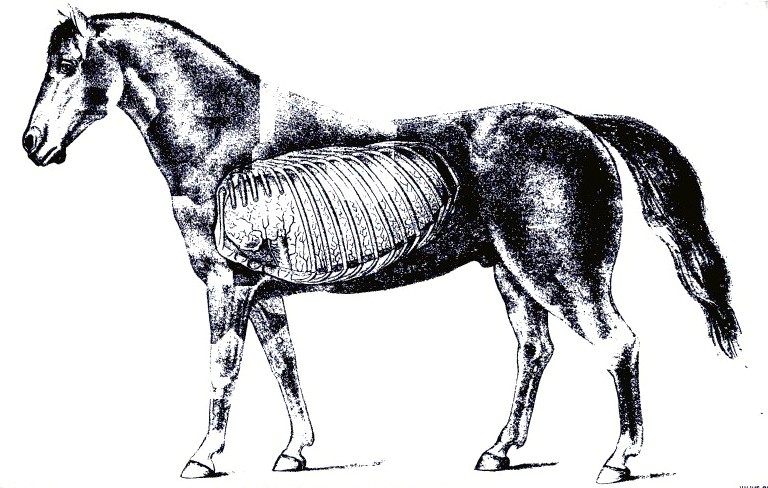
PLATE VII.
POSITION OF THE LEFT LUNG.

When the alarming symptoms have subsided active measures may be stopped, but care must be used in the general treatment of the animal for several days, for it must be remembered that congestion may be followed by pneumonia. The animal should have a comfortable stall, where he will not be subjected to drafts or sudden changes of temperature; he should be blanketed and the legs kept bandaged. The air should be pure, a plentiful supply of fresh, cold water always in the stall; and a diet composed principally of bran mashes, scalded oats, and, if in season, grass. When ready for use again the horse should at first receive only moderate exercise, which may be daily increased until he may safely be put to regular work.

terça-feira, 20 de janeiro de 2015

After having undergone severe exertion

After having undergone severe exertion

After having undergone severe exertion


The animal, after having undergone severe exertion, may not exhibit alarming symptoms until returned to the stable; then he will be noticed standing with his head down, legs spread out, the eyes wildly staring or dull and sunken. The breathing is very rapid and almost gasping; in most cases the body is covered with perspiration, which, however, may soon evaporate, leaving the surface of the body and the legs and ears cold; the breathing is both abdominal and thoracic; the chest rises and falls and the flanks are powerfully brought into action. If the pulse can be felt at all it will be found beating very frequently, one hundred or so to a minute. The heart may be felt tumultuously thumping if the hand is placed against the chest behind the left elbow, or it may be scarcely perceptible. The animal may tremble all over. If the ear is placed against the side of the chest a loud murmur will be heard and perhaps a fine, crackling sound.